Choosing an air fryer with two independent cooking rooms requires more than looking at overall capacity. The control method, basket separation, temperature adjustment, cooking-time control, airflow arrangement, cleaning access, and countertop layout can all influence everyday use. A dual-basket structure is particularly useful when different foods need different cooking settings or when two cooking tasks need to be handled at the same time. Understanding these design details makes it easier to identify a configuration that matches actual kitchen routines.
- 1. What Should You Know About the Control Design?
- 2. Why Use Two Independent Cooking Rooms?
- 3. How Do Dual Baskets Improve Cooking Flexibility?
- 4. How Should Capacity and Kitchen Space Be Considered?
- 5. Which Operating Details Matter Most?
- 6. What Should Be Considered for Cleaning and Maintenance?
- 7. How Can the Right Configuration Be Selected?
- 8. Frequently Asked Questions
A Knob design 2 Independent Room Dual Basket Air Fryer is designed around two separately controlled cooking spaces and a straightforward knob-based operating system. Instead of placing different foods into one shared basket and using a single setting, the independent-room concept allows each side to be managed according to its own cooking requirements. This structure can make meal preparation more flexible while keeping the controls simple and easy to understand.
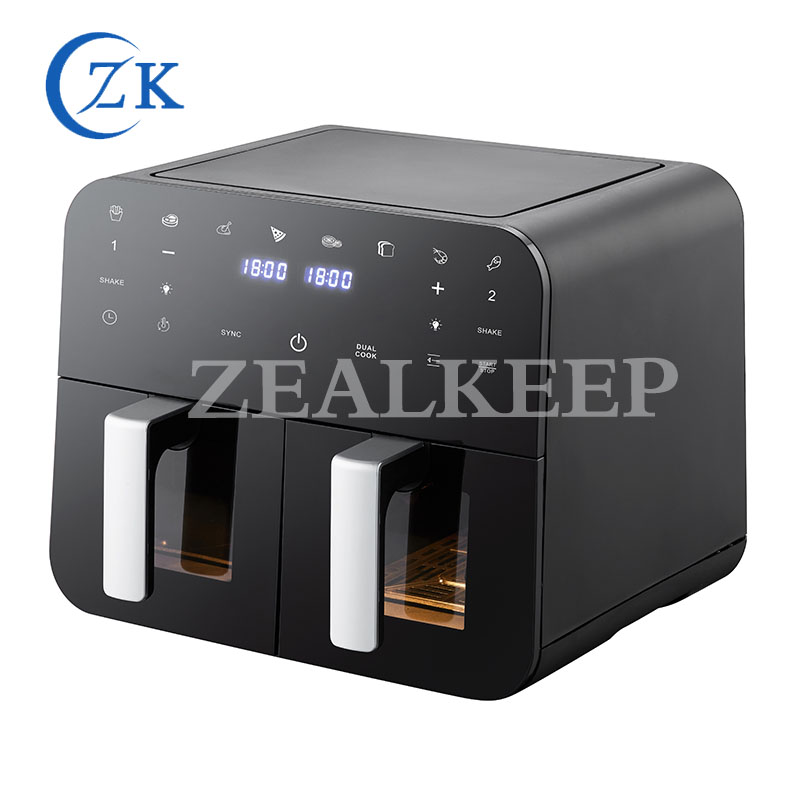
What Should You Know About the Control Design?
The control interface is one of the first features to evaluate because it directly affects how users interact with the appliance. A knob-based system uses physical rotary controls rather than relying entirely on a digital touch panel. This approach can make temperature and time adjustments straightforward during everyday operation.
Why Physical Knobs Can Be Practical
Rotary knobs provide a direct relationship between the user's hand movement and the selected setting. Users can visually identify the approximate position of the control and make adjustments without navigating through multiple digital menus.
- Simple adjustment of cooking temperature.
- Direct setting of cooking time.
- Clear physical feedback when turning the control.
- Easy access to separate controls for different cooking rooms.
- A familiar operating method for users who prefer mechanical controls.
Separate Controls Need Clear Identification
When an appliance has two cooking rooms, the controls should make it obvious which side they operate. Clear markings and logical knob placement reduce confusion, especially when the two compartments are running at different temperatures or for different durations.
Mechanical Simplicity
A simple control layout can also make routine operation easier for households that prefer clear physical controls. The design does not require users to learn a complex interface before adjusting basic cooking parameters.
Why Use Two Independent Cooking Rooms?
The main structural feature of a dual-basket appliance is the separation of its cooking areas. Two independent rooms allow foods with different preparation requirements to be cooked separately rather than combining them inside one shared chamber.
Different Foods Can Follow Different Settings
Not every food requires the same temperature or cooking duration. Frozen foods, vegetables, meat, snacks, and other ingredients may have different preparation requirements. Separate cooking rooms make it possible to adjust each side independently.
For example, one compartment may be used for a food requiring a higher temperature while another uses a lower setting. The two cooking processes can take place at the same time without forcing both foods into the same program.
Separation Helps With Food Organization
Independent compartments also create a physical separation between food groups. This can be useful when different ingredients need to remain separate during cooking.
| Design Aspect | Single Cooking Room | Two Independent Cooking Rooms |
|---|---|---|
| Temperature Setting | One cooking environment at a time | Each room can be adjusted separately |
| Cooking Time | Usually follows one selected duration | Different durations can be selected for each side |
| Food Separation | Foods share one main cooking space | Foods remain in separate baskets |
| Meal Planning | More dependent on matching food requirements | More flexible for different foods |
| Control Layout | One primary control area | Separate controls for independent cooking zones |
How Do Dual Baskets Improve Cooking Flexibility?
The basket is the direct interface between the food and the hot-air cooking environment. In a dual-basket configuration, each basket corresponds to an independent cooking room. This arrangement provides a practical way to separate foods while maintaining the compact format of one countertop appliance.
Different Foods at the Same Time
One of the most useful features of two baskets is the ability to prepare two different foods during the same meal preparation period. Instead of waiting for one food to finish before starting another, each basket can follow its own selected settings.
- Prepare different foods simultaneously.
- Use separate temperatures when the ingredients require different heat levels.
- Set different cooking durations for each basket.
- Keep food types physically separated.
- Organize portions according to the needs of the meal.
Basket Size Still Matters
Two baskets do not automatically mean that every type of food will fit comfortably. The usable dimensions of each basket should be considered separately. A narrow basket may be suitable for smaller portions but less convenient for large or irregularly shaped ingredients.
Internal dimensions, basket depth, opening size, and available clearance should therefore be checked before selecting a specific configuration. The total advertised capacity alone may not describe how easily food can be arranged inside each compartment.
Air Circulation Around the Food
Air-frying depends on circulating heated air around the food. Overfilling a basket can restrict airflow and create uneven cooking conditions. A practical basket design should therefore allow food to be distributed with sufficient space for hot air to move around the ingredients.
How Should Capacity and Kitchen Space Be Considered?
A dual-basket air fryer needs to balance cooking capacity with countertop space. Two independent rooms require a wider internal structure than many single-basket models, so the external dimensions should be considered alongside the available kitchen area.
Measure the Countertop Area
Before choosing an appliance, measure the available width, depth, and vertical clearance. Space should also be left around the appliance where required for safe operation and convenient access to the baskets.
- Measure the available countertop width.
- Check the depth of the cooking area and surrounding cabinets.
- Consider the height of upper cabinets or shelves.
- Leave enough room to open and remove both baskets.
- Keep the control area easy to reach during operation.
Think About Actual Meal Preparation
Capacity should be evaluated according to the foods normally prepared rather than by volume alone. Flat foods, small pieces, vegetables, snacks, and larger ingredients use basket space differently. The internal shape can therefore be just as important as the stated capacity.
Two Baskets Can Improve Workflow
Independent baskets can simplify meal preparation when two foods need to be cooked separately. The user can place each food in its designated compartment, select the appropriate settings, and manage the two cooking processes independently.
This arrangement is particularly useful for meals containing components with different cooking characteristics. It avoids the need to combine unrelated ingredients in one basket or repeatedly change settings between separate cooking batches.
Which Operating Details Matter Most?
A useful kitchen appliance should be understandable from the first operation. The relationship between controls, baskets, indicators, and cooking functions should be clear enough that users can operate the appliance without unnecessary steps.
Temperature Range
Temperature adjustment determines how the appliance can be used for different foods. A broader usable temperature range provides more flexibility, but the important point is whether the available settings match the intended cooking tasks.
Cooking Time
Time control allows users to determine how long each cooking room operates. Independent timing becomes especially useful when the two foods have different preparation durations.
Heating and Airflow
Heating elements and airflow systems work together to create the cooking environment. Hot air needs to circulate through the cooking chamber while the heating system maintains the selected temperature. Basket placement and internal chamber design can influence how efficiently air moves around the food.
| Operating Feature | What to Evaluate | Practical Consideration |
|---|---|---|
| Temperature Control | Adjustment method and available range | Should match the intended cooking tasks. |
| Time Control | Independent duration adjustment | Useful when two foods require different cooking times. |
| Basket Operation | Opening, insertion, and removal | Should be simple enough for regular use. |
| Airflow | Air circulation within each cooking room | Supports consistent exposure to heated air. |
| Control Visibility | Markings and knob positioning | Helps users identify the correct cooking zone. |
Clear Controls Reduce Operating Errors
When two cooking rooms are controlled separately, users need to understand which control belongs to which basket. Well-spaced markings, intuitive knob positions, and clearly defined cooking zones can reduce accidental adjustments during meal preparation.
What Should Be Considered for Cleaning and Maintenance?
Cleaning is part of the daily experience of any cooking appliance. Food particles and grease can collect inside baskets, around cooking surfaces, and near areas where food is transferred in and out of the appliance. A practical design should make routine cleaning reasonably accessible.
Basket Accessibility
The baskets should be easy to remove so users can empty and clean them without unnecessary handling. Smooth access also makes it easier to inspect the cooking area after each use.
Interior Cleaning
The cooking chamber should have accessible surfaces that can be wiped after the appliance has cooled. Areas around heating elements require particular care because they may collect residue during repeated cooking.
- Allow the appliance to cool before cleaning.
- Remove food residue from baskets after use.
- Clean accessible internal surfaces according to the manufacturer's instructions.
- Keep heating components free from accumulated food residue.
- Check that baskets and accessories are completely dry before reuse.
Material and Surface Considerations
The materials used for baskets, handles, exterior panels, and internal surfaces should be appropriate for repeated kitchen use. Smooth and accessible surfaces can simplify routine maintenance, while securely attached handles and properly finished edges contribute to everyday usability.
Cleaning requirements should always follow the appliance's specific care instructions. Not every component should be treated in the same way, particularly electrical parts and areas close to heating elements.
How Can the Right Configuration Be Selected?
Selecting a dual-basket air fryer is easier when the decision is divided into several practical questions. Instead of focusing on one feature, evaluate the controls, cooking rooms, baskets, capacity, cleaning access, and kitchen layout as a complete system.
- Define the cooking routine: Identify the foods and meal combinations that will normally be prepared.
- Check independent operation: Confirm that the two cooking rooms provide the level of separate control required.
- Review basket dimensions: Compare internal basket space with the size and shape of typical ingredients.
- Evaluate controls: Make sure temperature and time controls are clearly associated with the correct cooking room.
- Measure the kitchen space: Check countertop dimensions and clearance before selecting the appliance.
- Review cleaning access: Consider how easily baskets and accessible surfaces can be cleaned after cooking.
Match Features to Actual Use
More functions do not automatically make an appliance easier to use. A suitable configuration should provide the functions that correspond to the user's actual cooking habits. If independent cooking is the main requirement, clear dual-zone control and appropriately sized baskets should receive priority.
Consider the User Interface
Physical knobs can be useful for users who prefer direct controls. The ideal interface should make it easy to understand the selected temperature and time without unnecessary navigation. The control layout should also remain readable when the appliance is positioned on a countertop.
Zealkeep focuses on appliance configurations where practical kitchen functions are combined with straightforward operation. When evaluating a specific model, technical specifications should be checked together with the intended cooking routine, basket dimensions, control structure, and installation space.
Frequently Asked Questions
What does independent cooking room mean in a dual-basket air fryer?
It means the appliance has two separate cooking areas that can be managed independently. Each side can be used for a different food or cooking requirement.
Why use two baskets instead of one large basket?
Two baskets keep foods physically separated and allow different cooking settings to be used at the same time. This can make meal preparation more flexible when foods have different requirements.
Are knob controls practical for a dual-basket appliance?
Yes. Physical knobs provide direct temperature and time adjustment and can be easier to understand for users who prefer mechanical controls over digital menus.
What should be checked when evaluating basket capacity?
Check the usable internal dimensions, depth, opening size, and shape of each basket. These details determine how easily different foods can be arranged and how much space remains for air circulation.
Can two foods with different cooking times be prepared together?
The independent-room design is intended to allow separate cooking settings, making it possible to use different temperatures or durations for the two cooking areas.
How important is airflow in a dual-basket air fryer?
Airflow is essential because air-frying relies on heated air circulating around the food. Overloading a basket can restrict airflow, so food should be arranged with appropriate space.
What should be considered before placing the appliance on a countertop?
Check the appliance width, depth, height, basket opening direction, surrounding clearance, and accessibility of the control area. Adequate space makes everyday operation more convenient.
Key Points to Remember
A dual-basket air fryer should be evaluated as a complete cooking system rather than by one specification. Independent cooking rooms provide flexibility, while separate baskets help organize different foods. Knob controls offer direct operation, and practical basket dimensions determine how comfortably ingredients can be arranged.
- Check whether the two cooking rooms can be controlled independently.
- Compare each basket's usable dimensions rather than considering overall capacity alone.
- Review temperature and time adjustment methods.
- Consider airflow and avoid excessive basket loading.
- Measure countertop space and basket-opening clearance.
- Review cleaning access and the care requirements of each component.
The most suitable configuration is the one that fits the actual cooking routine, available kitchen space, preferred control method, and food preparation requirements. A clear understanding of these factors makes the selection process more practical and helps ensure that the appliance's dual-zone design is used effectively.